Global Experiences
The Oldest Fishing Village You Can Still Sleep In
A thousand years of the skrei run, fifty red cabins on stilts, and a general store unchanged since 1907 — the history of Lofoten's best-preserved fishing village, and how to sleep inside it.
The Oldest Fishing Village You Can Still Sleep In
A thousand years of the skrei run, fifty red cabins on stilts, and a general store unchanged since 1907 — the history of Lofoten's best-preserved fishing village, and how to sleep inside it.
Every winter for at least a thousand years, something improbable has happened in the dark water off the Lofoten Islands: millions of Arctic cod — the Norwegians call them skrei, from an old word for wanderer — leave the Barents Sea and swim south to spawn, arriving in January like a scheduled miracle. And every winter, for most of those thousand years, Norway rowed out to meet them.
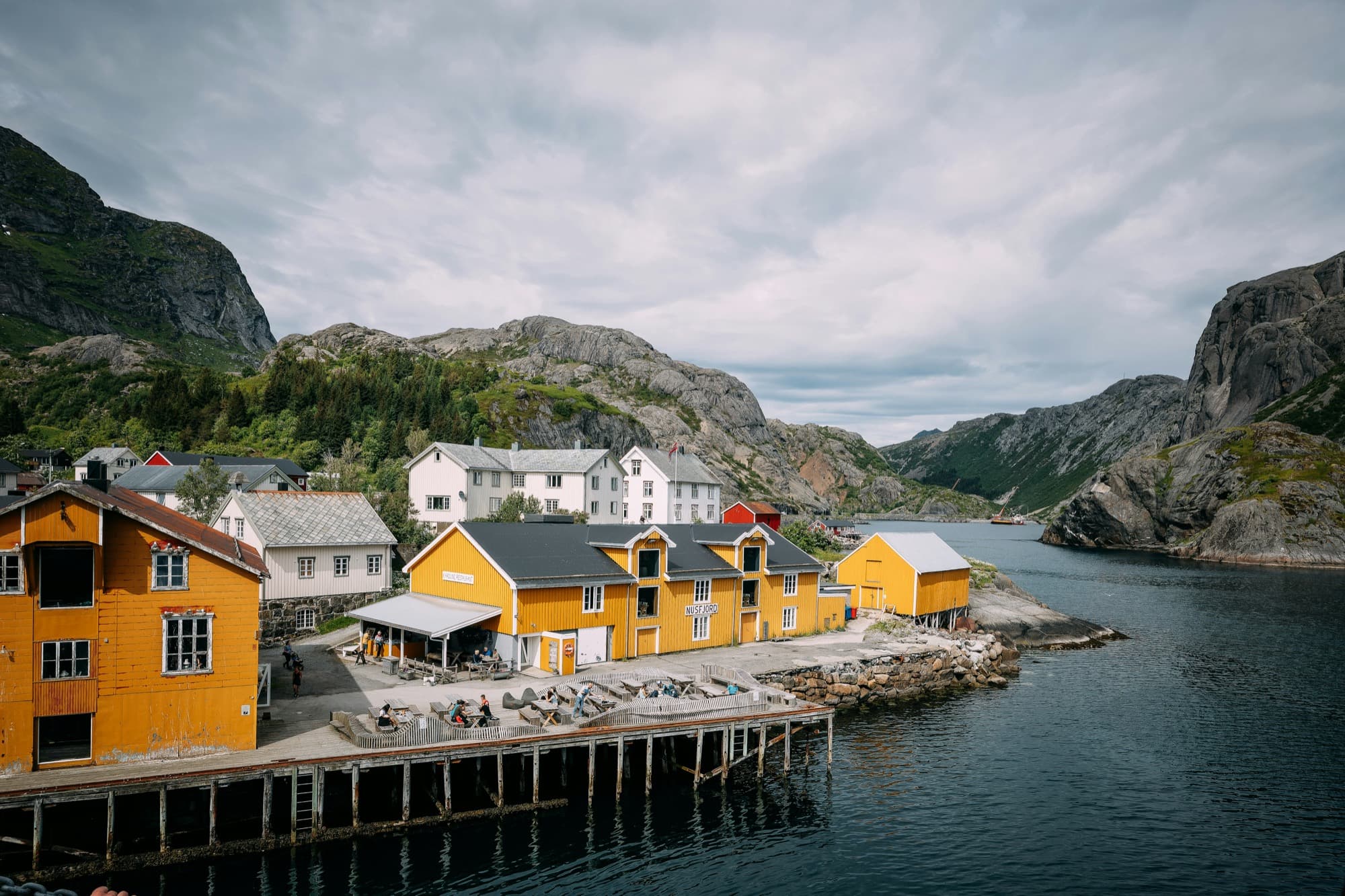
Nusfjord is what that appointment built. Tucked into a slot of a fjord on Flakstadøya, sheltered by rock walls that drop straight to the sea, it grew from the water up: first the fish, then the boats, then the red cabins on stilts to sleep the men who came for the fish. The sagas record boats provisioning for the Lofoten winter fishery before the year 900. By the early twelfth century, King Øystein was ordering cabins built for the visiting fishermen — arguably history's first purpose-built angler lodging, nine centuries before anyone said the word "lodge."
Today Nusfjord is routinely called one of the oldest and best-preserved fishing villages in Norway, and for once the superlative is understatement. The first road didn't arrive until the 1960s. No new building has gone up around the harbour since the fishery's golden age. The general store has been serving customers across the same elegant counter since 1907, beneath the same ceiling-hung buckets, beside a delightful old till that still instructs you to ask for a receipt.
The Rorbu: A House Named for Rowing
The village's signature — the red cabins standing over the water on stilts — carries its whole history in its name. Rorbu: "ror," to row; "bu," a small dwelling. You rowed here, and you needed somewhere to sleep. A millennium later, Norwegians still say they're "rowing fishing" when they join the season, three generations after the boats got engines.
Life inside was not the postcard. A rorbu slept eight to sixteen men, each arriving with a single "Lofoten chest" of dry food and clothes for a season of eighteen-hour days on polar water. The cabins stood on stilts partly so fish waste could be pushed through a hole in the floor straight into the sea — you can still find the hole in the heritage cabins. They were painted red and ochre because those were the cheapest pigments, mixed at home in cod liver oil. The prettiest architecture in Norway, it turns out, is a thousand small economies compounding into beauty.
At the peak, around 1905, some 1,500 fishermen and 500 boats worked out of this one small fjord — and the men who couldn't afford a rorbu bunk overturned their boats on the shore and slept beneath them. The catch went onto the hjell, the wooden racks you'll still see on the rocks, where the Arctic wind spent two or three months turning cod into tørrfisk — stockfish, a protein that kept for years, fed half of Europe, and was for centuries Norway's defining export. The racks still fill every winter. This is not a museum performing its past; it's a village that never stopped.
The Family That Kept It
In 1834 a man named Hans Grøn Dahl arrived, married the widow who owned half of Nusfjord, bought the other half in 1847, and built the village as we know it — the rorbuer, the general store, the forge, the bakery (1877, still baking), the docks, even a small power station in 1905, the third-oldest in Northern Norway. The Dahl name is still on the finest address in the village: the House of Dahl, the family's five-bedroom residence, now restored as its most exclusive stay.
One correction the record deserves, because it's repeated everywhere: Nusfjord is not a UNESCO World Heritage Site, whatever the blogs say. Its actual distinction is arguably more interesting — in 1975 it was chosen as one of three Norwegian pilot projects for the European Architectural Heritage Year, an early, deliberate act of preservation that explains why the village you walk today looks like the village of 1907. Precision matters in these things; the designation belongs to the story, and the story is true without embellishment.
What It Is Now
Twenty-some people live in Nusfjord year-round, alongside roughly fifty restored rorbuer that now sleep travelers instead of crews — the resort holding a Small Luxury Hotels membership and a Michelin Guide listing that the men of the Lofoten chests could never have imagined. The restoration runs in tiers, and choosing yours is choosing your century: harbour rorbuer with contemporary comfort behind the 1890s facades; the House of Dahl for the whole family; the Isolated Fisherman's Cabin, reached by boat, for the ones who mean it; and four government-protected heritage cabins kept exactly as they were — no running water, outhouse and all — for guests who want the truth.
The kitchens work the Arctic larder — Restaurant Karoline in an old warehouse on the harbour — and the village runs a conservation ledger worthy of its history: renewable energy where possible, menus built with local producers, a working partnership that plants a tree when you skip housekeeping, and continuous reinvestment in the historic buildings, funded in part by the modest entry fee day-visitors pay. Some 80,000 people walk through each year; the fee is why the boardwalks hold.
And the fishing never left. From late January through March the skrei still arrive on their thousand-year schedule, and you can go out for them the traditional way with the village's own captains aboard the wooden boats Elltor and Havdur — jigging for the same wanderers, in the same water, off the same dock. Boats run year-round for coalfish, halibut, and whatever the fjord offers; the northern lights handle the evenings from autumn through the dark months, and the midnight sun takes the summer shift.
Before You Go
Nusfjord sits six kilometers off the E10, thirty minutes from Leknes airport (two and a half hours from Oslo). Come late January through March for the skrei and the aurora sharing a sky; come June for daylight that never ends; come September for gold light and thin crowds. Book the heritage-cabin tier only if you understand what you're agreeing to — and book the winter weeks early, because the appointment the cod have kept for a thousand years is increasingly one travelers keep too.
See Nusfjord Village & Resort on the atlas →
Historical details verified against the village's own records and Norwegian heritage sources; the resort is the authority on current stays, seasons, and sailings. Nusfjord's preservation designation: European Architectural Heritage Year pilot project, 1975 — not, despite frequent misreporting, a World Heritage inscription.